



Over time, business operations tend to get more complex, and risks become unpredictable and ambiguous. Sophisticated cyber attacks, tightening regulations, disruptive technologies, fluctuating markets, and geopolitical events continuously morph the risk landscape.
A survey by PwC found that using advanced, predictive risk capabilities are 2.6x more likely to improve financial performance. For infosec teams, this means moving away from traditional methods to a proactive approach – predictive risk analysis.
What is predictive risk analysis? How does it work?
Predictive risk analysis combines machine learning, statistical models, historical data, and advanced analytical capabilities to forecast potential risks. This data puts patterns together to predict the probability of breaches, control failures, or operational disruptions.
Predictive risk modeling converts historical and real-time operational data into risk probabilities that supports decision making. Beyond identifying potential risks it estimated likelihood, timing, and severity of impact based on measurable signals.
Broadly speaking, the modeling process involves these stages:
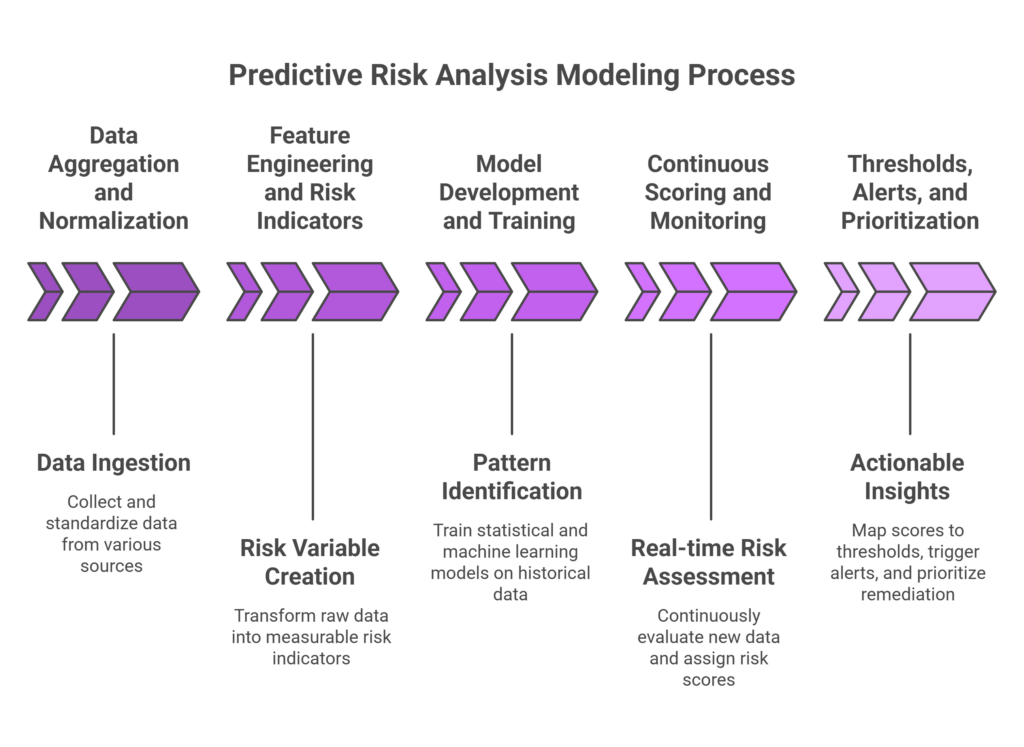
1. Data aggregation and normalization
The process starts by ingesting data from sources like incident logs, audit reports, previous control failures, configurations changes, failed access attempts, vendor risk indicators, and more.
This data is normalized into a consistent structure for deep analysis. The reliability of the model depends on the quality of this phase.
2. Feature engineering and risk indicators
Next, the raw data is transformed to risk indicators; measurable variables that correlate with risk. Commonly used indicators are user access change frequency, last control execution date, rate of unpatched audit gaps, or vendor response delays.
3. Model development and training
The training phase combines statistical models and machine learning algorithms to identify historical risk patterns. Depending on the use case or custom setting, the model can classify risk based on severity or likelihood and score it based on combined likelihood and impact.
4. Continuous scoring and monitoring
Post deployment, the model continuously evaluates new data and assigns a risk score to stems, users, vendors, and control. The score offers real time visibility into high risk areas and evolves based on environmental factors.
5. Thresholds, alerts, and prioritization
The risk scores mapped to thresholds to trigger actions based on the use case or model configuration. Automated alerts for high impact risks that require immediate attention and prioritize remediation queues allow teams to patch issues on time.
Where predictive analysis fits in the analysis spectrum
Predictive analytics fits into a broad spectrum of risk analysis methods:
- Descriptive analysis (What happened): Examines existing data like logs, audit reports, previous incidents to offer a baseline view of risk exposure.
- Diagnostic analysis (Why it happened): Delves deeper into past incidents to investigate contributing factors, root causes, possible correlations, unpatched vulnerabilities, control gaps. Identifying these factors helps to take corrective action.
- Predictive analysis (What will happen): Uses data and models to predict future risks. Forecast reports help in implementing preventive measures.
- Prescriptive analysis (What to do next): Recommends preventive measures, corrective controls, or interventions to minimize the likelihood of a breach. Often uses simulation or scenario analysis.
Depending on the problem or type of risk you’re trying to solve, you can use a combination of two or more.
Ideally, we recommend using all four types of analytics in tandem to develop a holistic risk picture that highlights what is failing, what requires attention, and what can go wrong.
How predictive analysis strengthens compliance and resilience
For compliance teams, better control validation, stronger governance, and cleaner audit outcomes means fewer emergency fixes, more stable workflows, and less manual rework.
When used right, predictive analysis becomes a practical tool for reducing compliance drift and building operational resilience.
Early risk detection
As predictive analysis generates insights from historical patterns and real time signals to identify risk hot spots, teams can intervene on time.
This capability helps teams move from reacting to incidents to anticipating which controls are likely to fail. Shifting from a phase of rushing to damage control to patching vulnerabilities before it is exploited means fewer audit surprises, faster action on critical risks, and fewer control breakdowns in production.
Better vulnerability management
Teams trying to implement a compliance framework deal with a wide range of failures. More often than not, the absence of controls don’t cause these failures, but when controls drift.
The ripple effect is felt across scattered evidence, delayed certifications, untracked exception requests, and unmonitored third party activities.
Predictive risk analysis helps to expose those weak signals before they escalate into security incidents or audit gaps.
When teams have clear insight into which controls are likely to break down, they can fix documentation gaps, normalize evidence collection, and close exceptions before they show up in testing.
Operational efficiency
Proactive compliance management reduces audit fatigue and last minute haphazard patchwork. More importantly, the overall quality of the control environment and posture improves. With predictive risk management, audits become a byproduct of good operations instead of firefighting drills.
The benefit is more than just passing audits – it is operational. Given its ability to highlight systems that are most likely to experience misconfigurations and identify assets with unusual privilege patterns, teams can prioritize remediation based on the level of criticality. This means they can focus on highly critical areas that require manual intervention.
Builds control resilience
As your business scales, change is the only constant. These changes inadvertently add risk to your posture.
Predictive risk analysis helps businesses absorb changes like new tools, processes, external vendors, legal obligations. It helps to manage uncertainties introduced by these changes to support resilience by signalling early warnings that allows teams to adjust controls before a small gap snowballs into an incident.
How Cura’s customizable tool mitigates risks using early signals
Cura’s predictive risk module is built on a flexible analytics layer that allows organizations to turn scattered data into actionable risk insights.
At its core, the module works by first connecting to multiple data sources. Organizations typically store risk and compliance data across systems databases, APIs, files, or platforms like SharePoint. Cura addresses this through a plugin-based connector architecture, similar to browser extensions. Teams can add connectors on the fly without system disruption to pull data from sources like SQL databases, APIs, or document repositories. This makes the platform adaptable to any client environment.
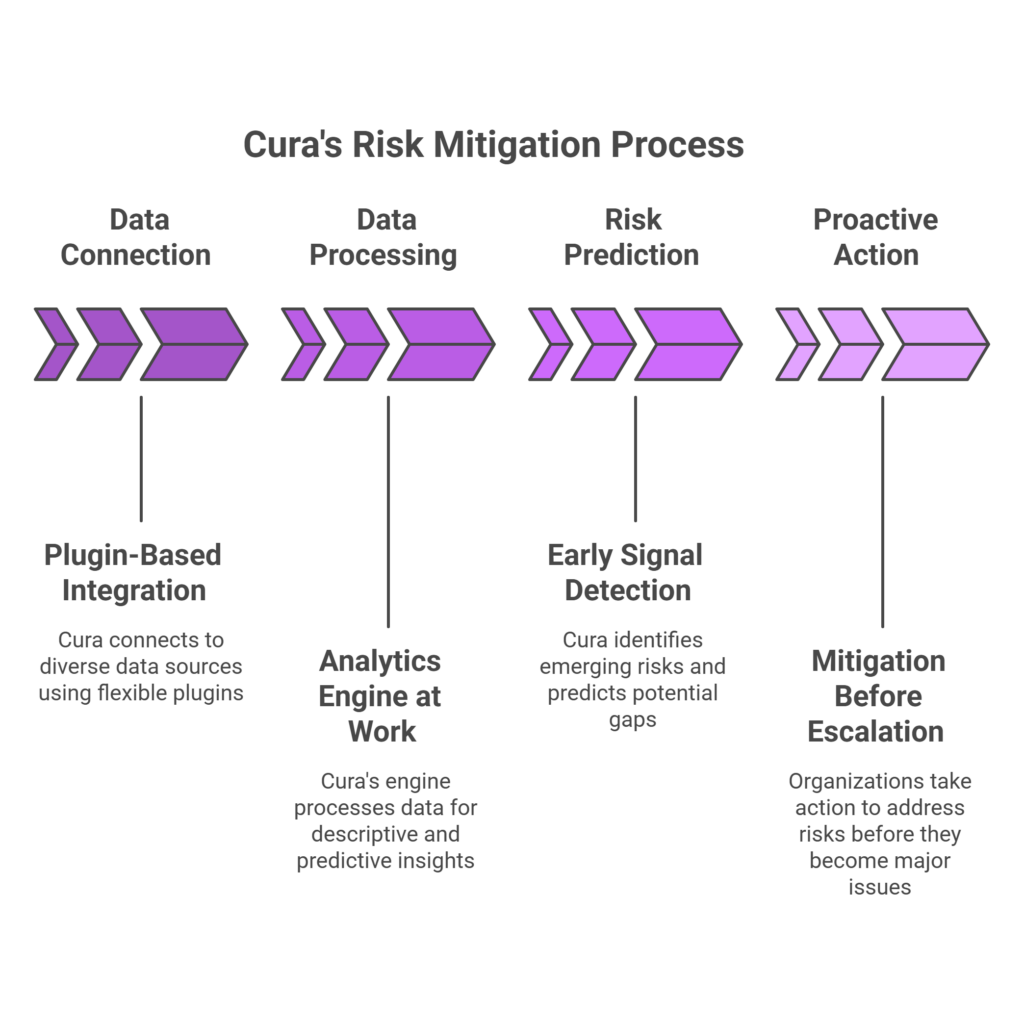
Once data is connected, Cura’s analytics engine processes it to enable both descriptive and predictive insights. The platform itself is domain-agnostic, meaning predictive capabilities are not limited to risk; they can be applied across compliance gaps, control effectiveness, or operational metrics. Within a GRC context, this translates into risk prediction, compliance gap forecasting, and trend analysis.
A key strength is its extensibility. Since connectors and capabilities can be added dynamically, organizations can continuously expand their data ecosystem without reconfiguring the platform. This ensures predictive models evolve as the business grows or introduces new tools.
Additionally, Cura supports custom analytics and predictive models tailored to specific organizational needs. Instead of relying on rigid, predefined logic, teams can configure models based on their risk frameworks, data structures, and business priorities. This allows for more accurate and context-driven predictions.
In practice, the module enables teams to move beyond static reporting. By combining real-time data ingestion, flexible integrations, and customizable analytics, Cura helps organizations identify emerging risks early, predict where gaps may occur, and take proactive action before issues escalate.
If you’re unsure where to begin or how to maximize the value of your risk analytics, reach out to Cura for a complimentary assessment.
Leave a Reply