


Modern GRC strategies function by consolidating multiple workflows and project pipelines into a single, holistic discipline. Businesses today rely on processes and technologies that shape the fundamentals for organizational resilience – with risk and compliance integrated at its core.
Despite its benefits, implementing the principles of GRC into every layer of operations is complex. For most businesses, irrespective of their size and resource bandwidth, GRC is a work in progress. To drive the program to a sustainable maturity level, is by adopting technology that is automated and actionable, continuous control monitoring (CCM).
CCM enables organisations to broaden the expertise at senior level, which helps them transition from ineffective point in time checks to a more holistic program that portrays a real time picture of the security posture. This way, IT teams know what to prioritize in order to manage compliance obligations effectively.
What is CCM and why is it important?
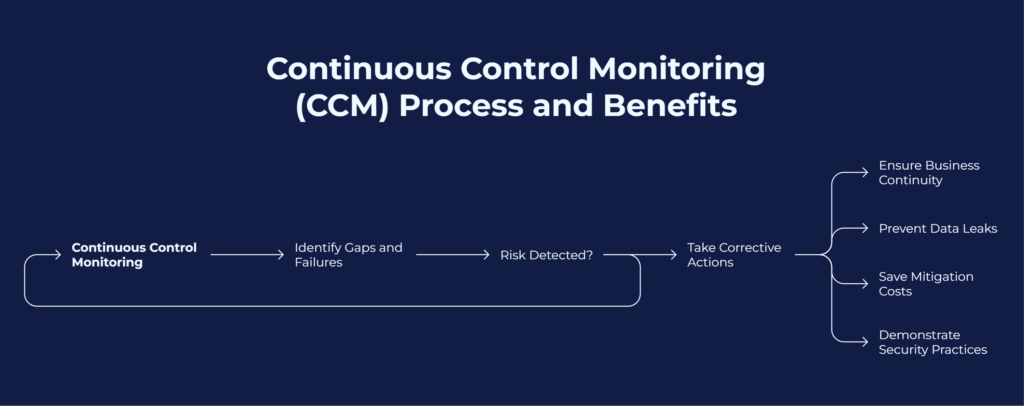
Continuous control monitoring refers to the practice of using automated, systematic technology that continuously evaluates the effectiveness of security controls to ensure they are functioning adequately. It helps to meet compliance obligations, reduce long term risks, and improve the overall posture.
The key goal of CCM is to identify compliance gaps and security failures so that IT teams can proactively take corrective actions against threats that can potentially lead to costly incidents or non-compliance.
Detecting security risks and vulnerabilities at earliest, before it escalates to a full blown incident is critical for several factors. It helps to ensure business continuity, prevents sensitive data from leaking into wrong hands, saves cost to mitigate the incident, and aids businesses to demonstrate strong security practices to their customers.
Evaluating the pitfalls of the current GRC landscape
GRC is a continuously evolving process – new technologies, changing regulations, and unforeseen risks add to its unpredictability. This volatile nature paved the way for a number of challenges and failures due to traditional, manual, or semi automated processes around monitoring critical controls.
For example, lack of point in time checks results in delayed detection time. If a breach occurs, by the time the IT team has sufficient context needed to mitigate it, the damage would be done. Another inevitable outcome of depending on manual or semi automated systems is significant loss of resource bandwidth to manage changing regulations and track complex data flow into systems.
These problems necessitate the need for a system like CCM that effortlessly manages, tracks, and updates GRC controls.
How is CCM shaping the GRC landscape?
CCM fills in the cracks where legacy processes fall short. It notifies relevant teams on time, flags errors before it contaminates critical systems, and eliminates the need to manually patch vulnerabilities.
Many businesses adopt a CCM program driven by artificial intelligence and machine learning. Advanced technologies like these analyze large volumes of data across the IT infrastructure like ERP, HR, finance, and other critical systems to identify control deviations, flag anomalies, and detect risks.
Based on the assumption that you are already familiar with the three components that make GRC; governance, risk, and compliance, let’s understand how CCM is shaping them.
Strengthening governance workflows
Governance is concerned with the policies, processes, and regulations designed to ensure accountability, transparency, and ethical behavior. CCM reinforces strong governance practices by:
- Enforcing policies: Continuously monitoring implemented controls against the applicable policies. For example, if an organization has access control policies for a certain sensitive information, the CCM system will trigger an alert if accessed by an unauthorized individual.
- Ensuring transparency: CCM helps IT teams gain real-time visibility into control effectiveness, enabling stakeholders to track performance. If an issue arises, it can be corrected promptly.
- Enabling decision making: Good governance requires transparency, accountability, and timely information. CCM delivers continuous insight into how business processes are operating and if controls are being followed. It ensures leadership has the data to make informed decisions and supports the ethical management of resources.
Building risk resilience
Risk is fluid and often difficult to predict using periodic assessments alone. Continuous control monitoring enables organizations to detect issues before they escalate into irreversible damage. It makes the overall risk management activities dynamic and responsive by:
- Third Party Risk Management: Collaborating with external vendors adds unprecedented risks to the IT environment. Continuously monitoring vendor compliance with SLAs, data handling requirements, and security policies helps to minimize the risk of third party breaches.
- Real time threat mitigation: Monitoring security controls in real time is critical to mitigate vulnerabilities as soon as they surface. This way, risks don’t translate to irrecoverable damages and helps to build resilience.
- Risk evaluation: CCM helps to evaluate risks empirically based on their likelihood, level of severity, and degree of impact using industry benchmarks. Risk matrix helps management to decide what risks to accept, mitigate, reject, or transfer.
Ensuring comprehensive compliance
Keeping up with the dynamic compliance landscape and heightened regulatory scrutiny is challenging and chaotic. CCM reduces the burden of manual control testing and ensures continuous alignment with compliance requirements. It helps compliance teams manage compliance obligations through:
- Continuous compliance: CCM evaluates controls in real time against compliance requirements and policies. If controls are not monitored in real time, businesses risk falling out of compliance, resulting in potential penalties and loss of customer trust.
- Better control effectiveness: Once implemented, it is imperative to check if the controls are functioning as they should. If a control is failing, the IT team can patch it on time to avoid non compliance.
- Compliance audit readiness: With CCM, organizations can maintain an audit ready posture. Automated documentation, control logs, and remediation tracking simplifies external audits and demonstrates a compliance first culture.
GRC is incomplete without CCM
Continuous Control Monitoring is no longer an optional activity. For fast scaling organisations struggling to thrive in a risk heavy, compliance driven world, it is a necessary enabler. When businesses gain real time visibility into control effectiveness, it helps them reduce human error, and gain actionable insights, and transforms traditional GRC from a reactive into a proactive function.
Leave a Reply